Posts

Blog #6: Visual

Image
 Merit-Aid Arms Race at Public Universities      Figure 1 shows that 339 public universities examined has spent approximately $32 billion on non-need-based aid from 2001 through 2007, whereas $49 has been spent on need-based aid. During this period, $2 out of every $5 of the institutional aid went to students who are able to afford college without financial aid.        Figure 2 shows how public universities’ use of non-need-based aid has dramatically increased. In 2000-01, 339 public universities spend about $1.1 billion annually on merit-aid for relatively affluent students; however, by 2016-2017, these schools were spending nearly $3 billion yearly on merit-aid.        As we can see in Figure 3, more than half of the 339 schools at least doubled the amount of money they spent on merit-aid; more than a third at least tripled the amount; and more than a quarter quadrupled the amount; about one in five schools quintupled the ...
Blog #5: Revised RQ, Works Cited

Research Question : How does merit-based college admissions reproduce inequality and stifle social mobility? Why has meritocracy become toxic even for those who seem to benefit the most from it? Can the inequality resulting from the meritocratic competition ever be justified? Works Cited Deresiewicz, William. Excellent Sheep: The Miseducation of the American Elite and the Way to a Meaningful Life. Free Press, 2015. Ho, Karen.   “Biographies of Hegemony.” The New Humanities Reader , edited by Richard E. Miller and Kurt Spellmeyer, 6th edition, Cengage Learning, 2019, pp. 160 – 181. Karabel, Jerome. The Chosen: The Hidden History of Admission and Exclusion at Harvard, Yale, and Princeton . Houghton Mifflin Company, 2005. Markovits, Daniel. The Meritocracy Trap: How America's Foundational Myth Feeds Inequality, Dismantles the Middle Class, and Devours the Elite. Penguin Books, 2020. Sandel, Michael J. Tyranny of Merit: What's Become of the Common Good?. Penguin Books, 2020.

Blog #4: Research Proposal

Research Proposal Working Title : The Dark Side of Merit-based College Admissions  Topic:  I will explore how the seemingly attractive principle of meritocracy exacerbates inequality by giving the elite class a greater relative advantage over the rest in gaining entry to prestigious colleges. I will discuss how it has become increasingly challenging for the low- and middle-class, who lack economic and cultural capital, to achieve social mobility. In addition, I will examine how the elite class, who seem to benefit the most from meritocracy, find themselves trapped inside the demeaning fears of not winning the meritocratic competition.  Research Question:  How does merit-based college admissions reproduce inequality and stifle social mobility? Are the affluent elite class negatively affected under such admissions system? If so, why have meritocracy become toxic even for those who benefit from it? Is there any way to make merit-based admissions game a fair play?...

Literature Review #3

Image
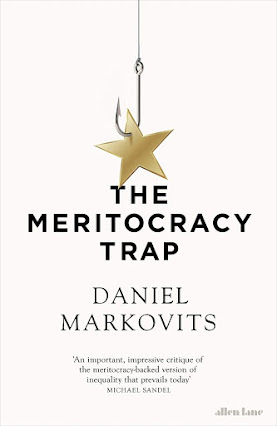
Markovits, Daniel. The Meritocracy Trap: How America's Foundational Myth Feeds Inequality, Dismantles the Middle Class, and Devours the Elite . Penguin Books, 2019. Summary  In this book, Daniel Markovits argues that meritocracy underwrites deserved advantage by purporting to ensure that social and economic rewards track achievement rather than breeding. Meritocracy produces a new form of hierarchy as rich parents invest heavily in education, creating a meritocratic inheritance that guarantees entrance to elite colleges and then for elite jobs. Meritocratic training and meritocratic jobs are connected through feedback loops. The elaborate education trains the meritocrats to possess exceptional skills and a huge capacity for work, shaping them into a superordinate working class. As new technologies are constantly being invented to suit elite labor force, the labor of the middle class becomes redundant and hence deemed worthless. Markovits criticizes how the elite class are operating...

Literature Review #2

Image
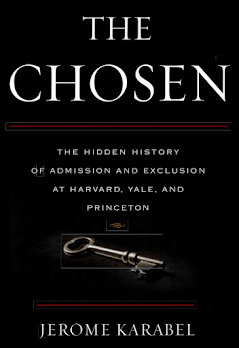
Karabel, Jerome. The Chosen: The Hidden History of Admission and Exclusion at Harvard, Yale, and Princeton . Houghton Mifflin Company, 2005. Summary:   The Chosen recounts a history of anti-Semitism and show how the Big Three—Harvard, Yale, and Princeton—constantly tweaked the admissions criteria to reduce the admission of Jews. Realizing that the definition of merit based solely on academic criteria was leading to unwanted students, the Big Three redefines merit, making highly subjective qualities such as “character” and “personality” central to the criteria. Karabel’s overarching theme is that admissions policy inevitably reflects the values and cultural ideals of the dominant group and that those decisions are inconsistent with the public interest. Inspired by Michael Young’s The Rise of the Meritocracy , Karabel believes that ideology of merit has its dark side as it ultimately deflects attention from real issues of inequality onto the unachievable social mobility. Author: Jer...

Literature Review #1

Image
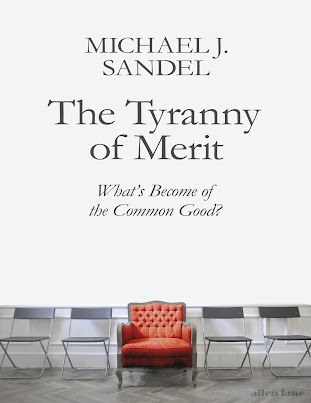
Sandel, Michael J.  Tyranny of Merit: What's Become of the Common Good?  Farrar, Straus and Giroux, 2020.   About the book The book discusses how the almost sacred principle of meritocracy is exacerbating inequality by reinforcing upper-class privilege. The hubris that meritocracy generates among the winners have led to a mistaken impression that winners have made it on their own while imposing harsh judgment on those left behind, who have no one to blame but themselves. The book also explores possible alternatives to meritocracy and discuss whether they could contribute to making a just society.   Author Michael J. Sandel is a political philosopher at Harvard University. His legendary course ‘Justice’ was the first Harvard course to be made freely available online and has been viewed by tens of millions of people around the world. His books touch upon the most vexing moral and civic questions of our time which include his bestsellers “What Money Can’t Buy: The Moral...

Blog#3- Research Question & Sources

Research Question: Recent series of college-admissions scandals have exposed the false meritocracy of the American Dream. In fact, the emphasis on one’s merit has produced unfair admissions competitions in which students from less privileged backgrounds are highly disadvantaged. Why has admission to elite universities become such a fierce competition? Is the meritocratic system itself the biggest obstacle to creating a fair society? Can a fair meritocracy ever exist? Academic Sources: Liu, Amy. “Unraveling the Myth of Meritocracy Within the Context of US Higher Education.”  Higher Education , vol. 62, no. 4, Springer, 2011, pp. 383–97, doi:10.1007/s10734-010-9394-7. Mads Meier Jæger. “Equal Access but Unequal Outcomes: Cultural Capital and Educational Choice in a Meritocratic Society.”  Social Forces , vol. 87, no. 4, University of North Carolina Press, 2009, pp. 1943–71, doi:10.1353/sof.0.0192 Nahai, Rebekah N. “Is Meritocracy Fair? A Qualitative Case Study of Admissions at t...